
Do we need a leader? (Mehdi Moussaïd) — understanding collective intelligence
Introduction
We often talk about collective intelligence as if it appeared “by itself” as soon as we put people in a room. In Do we need a boss? A short treatise on collective intelligence, Mehdi Moussaïd defends a simple idea: a group becomes efficient when we install a method of coordination, a decision rule and some safeguards against bias.
Here, I summarize the essentials and translate that into practice for the company (marketing, e-commerce, product, ops): decide better, faster, without depending on a “hero boss”.
1) The real question: “how do we decide?” more than “who is in charge?”
The “leader or not leader” debate often misses the mark. What really hurts is the lack of a framework. Without rules, a collective can engage in endless discussions, get hung up on details, or decide nothing.
Conversely, a team can self-organize very well if it knows how to answer three questions:
What is the objective? (and how we measure it)
What information matters? (and who owns it)
How do we decide? (criteria + final manager + timing)
2) When collective intelligence really works
A group is useful when information is distributed. Each person has a piece of the puzzle: customer feedback, figures, technical constraints, product vision, field experience. The collective then becomes a set of branches.
Two conditions make the difference:
Useful diversity: different points of view that improve the diagnosis (not just “more people”).
Clear aggregation: a simple way to transform opinions into decisions (otherwise, it’s just noise).
Practical rule: the higher the uncertainty, the more you gain from multiplying the signals. But the more you have to frame the decision.
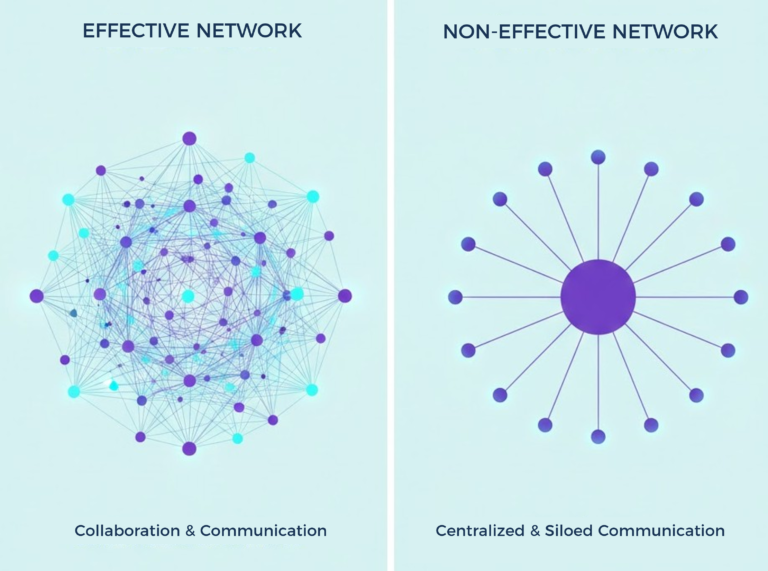
3) Why a group can become less good than an individual
Teams are not lacking in ideas. They often lack a “small framework” to prevent biases from taking over.
Common pitfalls :
Conformity: we align ourselves with the most assertive opinion, not necessarily the most accurate.
Cascade of opinion: the first opinion expressed influences everything else.
Polarization : in a group, we can end up with a more extreme view than each person initially intended.
Weak consensus: we choose the least controversial option, not the one that works best.
The good news: we don’t “moralize” a bias. We circumvent it with a simple rule at the right time.
4) The method: moving from discussion to decision
Collective intelligence is a design. You organize how we gather information, how we discuss, how we decide, and then how we learn. And that changes everything.
4 easy-to-apply rules :
Separate ideation and decision-making: explore first, then choose.
Collect opinions before the meeting (in writing): less social influence, more precision.
Définir des critères : KPI, risques, effort, dépendances, coût d’opportunité.
Nommer un responsable final : quelqu’un tranche, documente, et assume la suite.
As a result, the role of a “leader” (when one exists) becomes healthier: to clarify, protect time, accelerate and maintain a learning loop.

5) Concrete examples in marketing and e-commerce
A) Acquisition: validating creative work without pointless debate
Classic scenario : the team spends 45 minutes commenting on an ad, giving it ratings… and in the end, nothing is decided.
A simpler approach : everyone submits 10 angles in writing → we vote quickly → we test 3 → we decide based on the signals (not impressions).
Result : in one week, you can go from 1 test to 3–5 tests depending on your resources, without endless meetings.
KPIs to track : number of tests per week, time from brief to launch, CPA/ROAS (depending on your model), creative rejection rate.
B) Offer : to relay feedback from the field without distorting it
A team truly becomes more “intelligent” when it gathers concrete customer signals, not just impressions: recurring objections, selection criteria, fears, reasons for purchase. It’s often in these details that the best value proposition lies.
Even with a highly targeted clientele, profiles are never entirely identical. They may be similar in some ways, yes… but they diverge in others (level of expertise, time constraints, budget, purchasing context). And it’s precisely this diversity that provides valuable feedback, because it brings to light nuances you wouldn’t see from the inside.
C) Management: making quick decisions on priorities (without "ping-pong meetings")
Typical scenario : everyone agrees there’s “too much to do,” then we leave with 12 priorities. The collaborative approach that works: each person comes prepared with 5 written priorities (and the “why”), we vote in 3 minutes, then keep only the top 3. A designated leader then makes any ties and clearly states: “We’ll do this this week; it can wait.”
Concrete example : a marketing team that used to spend 1.5 hours per week can reduce this to 25-30 minutes simply by separating “gathering feedback” (before) and “decision-making” (during).
KPIs to track : number of decisions made per week, average meeting time, rate of tasks abandoned (too late), time between idea and launch.
D) Management / organization: distribute the work without "I do everything" (and without jealousy)
Each task is written on a single line with 3 fields: “value,” “urgency,” and “effort” (low/medium/high).
Each person announces their realistic “budget” in 2 minutes (e.g., 12 hours available, not 25).
Assignment: We start with the tasks with the highest value and urgency, distribute them to balance the workload, and block out 20% of the time for unforeseen events.
Direct effect : less hidden overhead, fewer delays, and above all, greater clarity on what won’t be done (instead of discovering it too late).
KPIs to track : on-time delivery rate, “unplanned” overtime, number of postponed tasks, and blocking dependency rate (tasks awaiting validation or an asset).
Quick checklist : collective intelligence
Meeting objective : ideation OR decision
Feedback collected before the discussion : written, anonymous
Defined criteria : KPIs, risks, constraints, effort
Clear roles : decision-maker / contributors / implementers
Timebox + expected output : decision or next step
Published decision : (document) + responsible party + deadline
Post-decision review : lessons learned + adjustments
Continuous improvement loop : weekly, monthly, or bi-monthly
FAQ — Collective intelligence and leadership
Does a team need a leader to be effective?
Not always. But a framework is always necessary: objectives, a decision-making process, and learning opportunities. Leadership can be a role (clarifying, making decisions, protecting time) rather than a status.
Why does collective intelligence fail in companies?
Often due to a confusion between ideation and decision-making, uncontrolled social influence, a lack of criteria, and the absence of written records of decisions.
How can meetings be made productive quickly? Gather information in writing before the meeting, establish explicit criteria, implement a strict timeframe, and ensure that the final decision is accountable. Then: document the decision and measure its impact.
Conclusion
The key point: collective intelligence isn’t just an atmosphere. It’s a structure:
information → discussion → decision → learning.
A leader can help… especially if they serve the framework rather than their own ego.
Référence : Moussaïd, Mehdi; “A t-on besoin d’un chef : petit traité d’intelligence collective”; Allary Editions; 2025