
Why choose a freelancer over an agency? A complete analysis to help you decide with confidence.
Introduction
Are you hesitating between a freelancer and an agency to manage your marketing (Google Ads, Meta, LinkedIn, landing pages, tracking)? That’s perfectly normal. There’s no universally “best” choice. In practice, it all comes down to a few very simple criteria: your budget, your need for flexibility, the importance of a direct relationship, and the level of specialized expertise you expect.
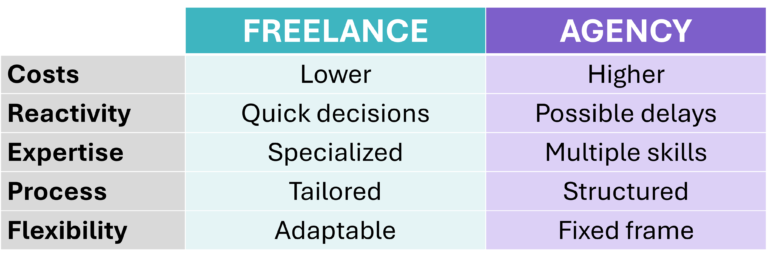
If I had to summarize the essentials in 30 seconds: a freelancer is often ideal when you want to move quickly, speak directly to the right person without intermediaries, and pay for both execution and strategy (not for an agency structure). An agency is often more relevant when your needs are broad (many channels, many deliverables) and you want a turnkey solution with guaranteed continuity. There you have it. And if you want to delve deeper, I’ll detail the advantages, limitations, and provide a checklist to help you decide stress-free.
For my part, I have a very “performance-oriented” approach (acquisition, conversion, tracking) but also a very “psychological” one (neuromarketing, friction, emotional triggers). And precisely, this dual perspective often changes the decision.
1) The advantages of a freelancer
A. A direct relationship (and that changes everything)
With a freelancer, you’re talking to the person doing the work. Not a salesperson, not a project manager who just relays information, not “the team.” The result: less information loss, fewer back-and-forths, and greater precision.
And it’s also psychological. When the relationship is direct, trust builds faster. Your constraints are better understood. Your working methods are better adapted. And often, you dare to speak up about the real issues (“I don’t understand,” “I’m afraid of blowing the budget,” “I want things to be simple”). That’s invaluable.
B. Greater flexibility and responsiveness
A freelancer can adapt their work to your pace: a 48-hour sprint before a launch, a rapid iteration on a landing page, same-day tracking fixes if something breaks.
A concrete example: for a small e-commerce business, a simple tracking correction (incorrectly recorded purchase events) can save 1 to 2 weeks of “blind” management. Two weeks is a long time when you’re spending €30–80 per day on ads. You get the idea?
C. Often more transparent regarding costs
An agency has structural costs: premises, management, processes, internal margins, etc. This isn’t “bad,” it’s just a model. A freelancer is generally leaner, so you pay more for their expertise and actual time spent.
To help you compare, here’s a simple table (which you can adapt):
| Model | How it works | When it’s relevant |
|---|---|---|
| Monthly Fee | A fixed price for a defined scope | Stable needs, clear expectations |
| Daily rate / hourly rate | You pay for the time spent | One-off missions, audits, tracking redesign |
| Fixed + performance mix | A base salary plus a bonus based on results | When the conversions are well-defined and the framework is clear |
D. More specialized expertise (and personal involvement)
Many freelancers specialize in specific areas: pure Google Ads, GA4/GTM tracking, CRO, copywriting, etc. Their reputation depends directly on the quality of their deliverables. There’s no safety net.
Another important point: when you work directly with an expert, you often have more collaborative development. And the more involved you are, the better you understand what works. This prevents you from blindly relying on a single provider.
E. More personalization (less “copy-pasting”)
In some agencies, there are templates, standardized processes, and campaign models. This can be effective… or too generic. A freelancer tends to adapt more: message, structure, landing page, angles, tests, and even the way they support you.
2) The disadvantages and risks of chosing a freelancer (things to know)
A. Continuity and “structure”
A freelancer is a person. So yes: illness, overload, vacation, unforeseen events… these things happen. And there isn’t automatically a team to take over.
Simple solution: establish a clear framework.
- Contract + scope + deliverables
- Documentation (tracking, account structure, access, naming conventions)
- Regular check-ins (even short ones)
- Handover clause if needed
B. Not all freelancers are created equal.
It seems obvious, but it’s the real risk. To mitigate this:
- Ask for concrete examples (not just “I’ve managed accounts before”)
- Ask for the rationale (why this targeting? why this structure?)
- Check their ability to explain things simply (a very good sign)
C. Highly “multi-skilled” projects
If your project requires a combination of factors—overall strategy, branding, complete website, SEO, Ads, design, content, video—an agency might be more suitable. Alternatively, a hybrid model could be considered: a freelance “conductor” plus a small team of specialists.
3) The advantages of an agency
A. An integrated multidisciplinary team
That’s the major advantage: an agency can quickly mobilize multiple skills. You don’t have to search for three different service providers. And if you need a large production volume, it’s very convenient.
B. Greater “structural” continuity
Even if your contact person changes, the agency continues. There are often processes, internal tools, and intermediaries. For some SMEs, this is reassuring.
C. When an agency is often a good choice
- You have a comfortable budget and extensive needs (multiple channels + production).
- You want end-to-end management with structured reporting.
- Your project requires significant coordination (campaigns + creative + content + development).
4) Decision-making checklist (quick and useful)
Ask yourself these questions:
- Budget: Can I fund an agency and a team, or do I want to optimize every euro?
- Urgency: Do I need rapid iterations, sometimes outside the established process?
- Complexity: Is this a highly multi-skilled need or a more specific one (Ads, tracking, landing pages)?
- Relationship: Do I want to speak directly with the person doing the work and work in real time?
- Duration: Short-term project (audit/setup) or long-term collaboration (monthly monitoring and optimization)?
- Risk tolerance: Does the idea of having a single person stress me out, or is it acceptable if everything is well-defined?
If you primarily want a “fairly specific need + speed + direct relationship + controlled budget,” then freelancing is often the right move. If you primarily want a “very broad need + production + team continuity,” then an agency makes sense.
5) The added-value "neuromarketing" element in this choice
The added benefit of neuromarketing becomes crucial when your goal isn’t just to drive traffic, but to convert leads.
A freelance neuromarketing specialist will uncover what’s truly holding your customers back: their doubts, their hesitations, their fears, their poor wording, and the lack of trust signals.
In practical terms, this translates into more accurate ads, more compelling landing pages, and greater consistency between promise and experience. While a non-specialist provider will often focus solely on optimizing campaign settings, the neuromarketing approach also optimizes persuasion (without manipulation): clarity, reassurance, evidence, visual hierarchy, and word choice.
Conclusion (and ethical point)
Freelancing or agency: both can be excellent… or disappointing. The difference lies primarily in how well they fit your specific situation and the quality of the framework (objectives, tracking, methodology, communication).
One last important point: these choices are based on trust. Therefore, ethical conduct is essential. No unrealistic promises, no “magic” numbers, no pressure. We proceed with hypotheses, we measure, we adjust. That’s how we build healthy growth.
If you’d like, we can discuss this simply: a short, free, no-obligation chat to see if your needs lean more towards “freelancing” or “agency,” and what I would recommend in your case.